The Django NYC
CLIENT
King & Partners
TECHNOLOGIES
Ruby on Rails, WordPress (Headless), REST API, JavaScript, SASS
YEAR
2022
EXTERNAL URL
Frontend development for a subterranean jazz club and restaurant in the Roxy Hotel — the third GrandLife property I built on the shared Rails and headless WordPress architecture, after the Soho Grand and Soho Diner. Performance-driven platform with nightly event scheduling, Resy reservations, panoramic venue views, and editorial content.
Development lead on this project at King & Partners.
Background
A world-class jazz venue needed a digital presence with the same energy as a live set.
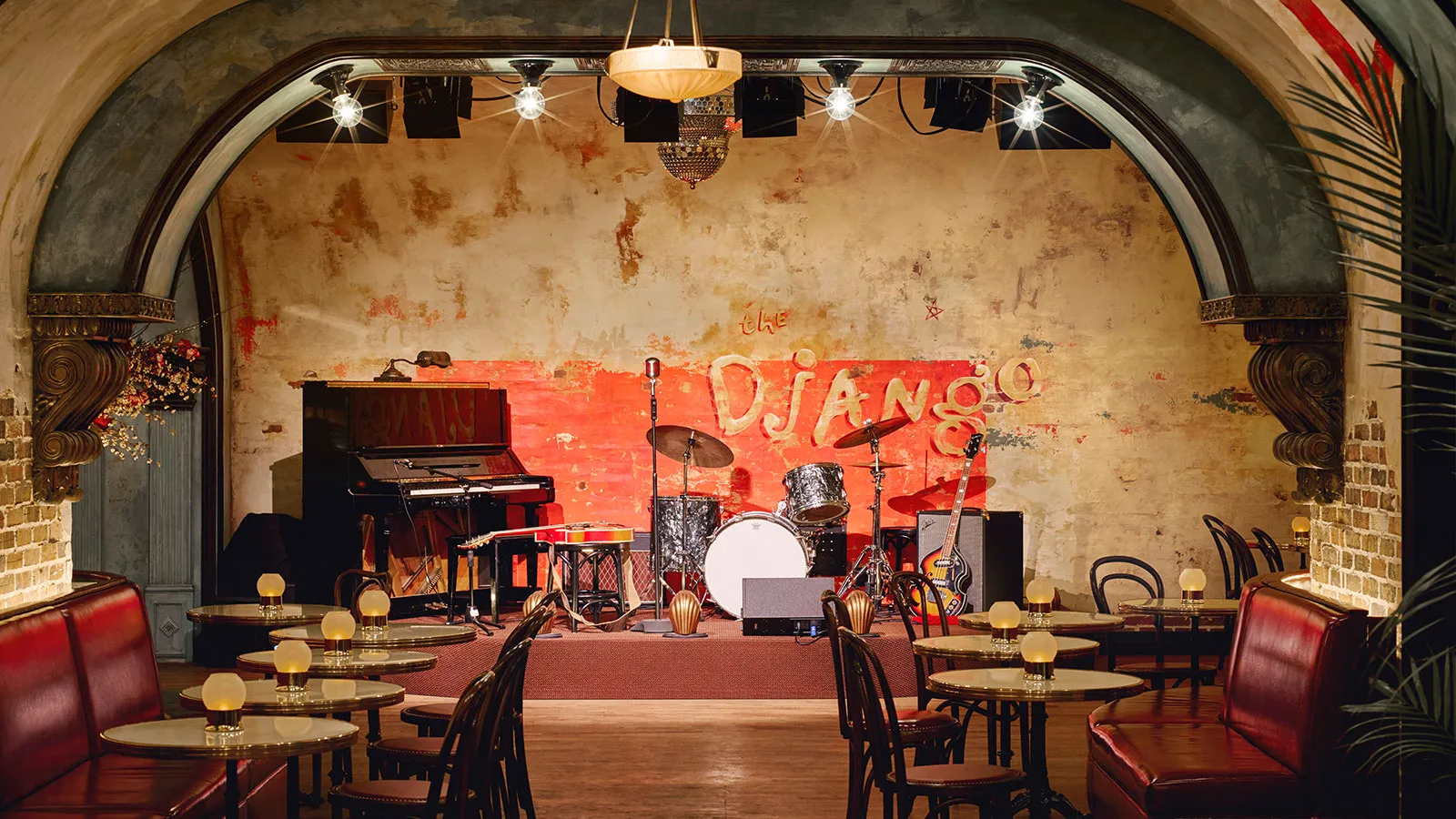
The Django — a subterranean jazz club in the cellar of the Roxy Hotel at 2 Avenue of the Americas in Tribeca — programs live jazz seven nights a week across two nightly sets, drawing both rising talent and established artists to a room modeled after the intimate boîtes of Paris. With vaulted ceilings, exposed brick walls, a state-of-the-art Meyer Sound system, two cocktail bars, and a dinner service anchored by an award-winning cocktail program from mixologist Natasha David, the venue had built a loyal following since opening in 2015. King & Partners, the Roxy Hotel’s long-standing agency partner for strategy, branding, and digital, brought me on to lead development on The Django’s standalone web platform — a site that needed to capture the energy of the room and convert it into reservations, ticket sales, and private event inquiries.
The site had to serve jazz enthusiasts, casual diners, hotel guests, and event planners — each with different entry points and conversion goals — while establishing The Django as a destination in its own right, distinct from the Roxy Hotel property site.
Implementation
Extending a proven headless architecture with venue-specific features built for nightly programming.
By the time I started The Django, I had already shipped two properties on King & Partners’ decoupled stack — the Soho Grand flagship and Soho Diner. That familiarity with the Rails frontend, WordPress REST API layer, and multisite content infrastructure meant I could focus entirely on what made this venue different rather than re-learning the platform.
The Rails frontend delivered custom page templates with an event schedule and date-based calendar navigation via Pikaday, image carousels powered by Swiper.js, a 360-degree panoramic venue viewer using Pannellum.js, and a visual identity built in SASS with custom typography — Bernhard, Geometric Heavy, and Tilda Petite typefaces paired against the venue’s signature red (#ec4429) and textured paper backgrounds. WordPress Multisite served as the CMS, giving the client full editorial control over the performance schedule, dinner menus, photo galleries, stories, and private event details through a familiar admin interface. Third-party integrations included Resy for table reservations, Contact Form 7 for private event inquiries, and OneTrust for cookie consent management.
Like the Soho Grand and Soho Diner before it, The Django ran on its own domain and codebase while sharing the underlying WordPress Multisite content infrastructure — a separation pattern that gave each venue its own visual identity without duplicating the CMS layer.
Results
A digital platform that keeps pace with seven nights of live jazz.
The site launched as a fully operational platform supporting nightly performance schedules, dinner reservations, private event booking, photo galleries, and editorial content — giving The Django a digital identity proportional to its reputation as one of New York’s premier jazz venues. The headless architecture delivered fast page loads despite rich imagery, embedded panoramic views, and multiple third-party integrations. The WordPress editorial layer performed as designed: the venue’s team published performance schedules, updated menus, managed gallery content, and handled event details independently, with no developer involvement required for ongoing content operations.
The platform continues to serve The Django years after launch. Across all three GrandLife properties — Soho Grand, Soho Diner, and The Django — the shared architecture proved that a single decoupled stack could support venues with fundamentally different audiences and content needs, from hotel booking to nightly jazz programming.